Saturday, July 24, 2010

(A Double-Barreled) Did You Know #27

This has been, to me, the most enjoyable work in preparing a post to our family blog. It is filled with some of my fondest memories growing up: gathering around the old black and white, and especially Bonnie's enjoyment at the certainty that SHE was going to be the very first victim in EVERY single episode. As the familiar theme wafted towards her bed her anticipation would build until finally, as pistols blazed, she would exclaim, "Ouch, they got me!" Even today, if you were to call my cell phone, that familiar theme serves as my ringtone.

James King Aurness was born in May 1923 in Minneapolis, MN. As a young man he already towered over his classmates as he was on his way to his familiar height of 6' 6". During the second World War he served with 3rd Infantry Division and served a leading role in the invasion of Anzio, where he sustained a severe leg room that would plague him as he ages and was noticeable in his work as he mounted and dismounted his horse. Urged by his younger brother, James made his way to California to begin his acting career, appearing first in "The Farmer's Daughter" (1947). Following the advice of that movie's director, H.C. Potter, James "Aurness" became James "Arness."

Perhaps his biggest break came from his work with John Wayne. After making a few movies together, he was on the Duke's mind when he was approached with the offer of starring in a new television program based on the popular radio show, Gunsmoke. Wayne was not interested, but he knew just who to recommend, and he even introduced the first episode (you can see his introduction on YouTube)

From 1955 until 1975 James Arness kept the peace in Dodge City, tried to keep the peace between Doc and Chester (and later Festus), and kept from kissing Miss Kitty. Following the end of the television series he starred in How the West Was Won television series, the short-lived McClain's Law (1981), and a re-make of John Wayne's Red River (1988), and a number of made for TV Gunsmoke movies.

He was married to Virginia Chapman from 1948 until their divorce in 1963. They had three children. His only daughter, Jenny, appeared in two episodes of Gunsmoke, but sadly she died of a drug overdose in 1975, just as Gunsmoke was ending its run. James Arness and Janet Surtrees were married in 1978.

If we are related to James Arness, that obviously we are related to his younger brother, Peter Graves (born in 1926), who likewise had a long-running television career at Agent Jim Phelps in "Mission: Impossible" (1966). Peter made many movies, one of the most memorable being the pilot on Airplane (1980). Sadly, Peter passed away on March 14th of his year.

To find the family connection we must go back a number of generations to John of Gaunt, Prince of England (1340-1398), son of King Edward III (1312-1377). John had a number of wives, but in 1395 he married Catherine de Roet, Duchess Of Lancaster. The chart below traces out the two family lines:

Prince John of Gaunt and Duchess Catherine de Roet
John "Fairborn" De Beaufort
Marquess Of Somerset b.1373
Joan De Beaufort b.1379
Joan Beaufort b.1398
Jane Neville b.1399
Annabella Stewart b.1440Thomas Hare b.1418
Elizabeth Gordon b.1462John Hare b.1438
Robert Keith b.1483Nicholas Hare b.1460
Janet Keith b.1514John Hare b.1506
William Lyon b.1540John Hare b.1526
Richard Lyon b.1590Elizabeth Hare b.1555
Richard Lyon b.1624Richard Ward b.1575
Richard Lyon b.1653Gov. Andrew Ward I b.1597
Daniel Lyon b.1697Esther Ward b.1623
Ruth LyonDaniel Burr b.1660
Levi BeardsleyElizabeth Burr b.1696
Esther Beardsley b.1791Nathaniel Hull b.1726
Ann Maria Graves b.1820Ezekiel Hull b.1765
Josephine Jenks b.1841Platt Hull b.1787
Hess Graves Duesler b.1859
Ezekiel Hull b.1813
Ruth Duesler b.1894
Rebecca L. Hull b.1841
James King Aurness (ARNESS) b.1923 and Peter Duesler Aurness (Graves)
Frank Martin Bragg b.1867
Orval Bishop Bragg b.1895

Don Cicero Bragg b.1920

As the above chart illustrates, James Arness, Peter Graves and Frank Martin Bragg (our great-grandfather) are 18th cousins, being three generations later we are 18th cousins 3 times removed of James Arness and Peter Graves.

Friday, June 25, 2010

Did You Know #25

As you read these words you should be able sense our extended family tree becoming more and more ponderous. Stepping out on this particularbranch will bring you face to face with some of the great names of our time, in Hollywood (R. Burton), business (Hilton), and politics (Warner), and the inspiration for the number one hit of the Statler Brothers. And it can all be found by looking into the incredibly pulic life of one of motion pictures most admired actresses, and our grandfather's 9th cousin.

Here is the connection...

Gov. Andrew Ward I & Esther Sherman
Samuel Ward b.1645

Esther Ward b.1623
Samuel Ward b.1677

Daniel Burr b.1660
Elizabeth Ward b.1708

Elizabeth Burr b.1696
Mary Harris Hinman b.1749

Nathaniel Hull b.1726
Rhoda Hinman b.1774

Ezekiel Hull b.1765
Jonathan Perigo

Platt Hull b.1787
Margaret Jane Perigo b.1830


Ezekiel Hull b.1813
Francis Marion Taylor b.1860

Rebecca L. Hull b.1841
Frank Martin Bragg b.1867

Francis Lenn Taylor b.1897
Orval Bishop Bragg b.1895

Elizabeth Rosemond Taylor b.1932

Born in London, England (her mother, a retired actress, and father, art dealer, were in England on business), "Liz" Taylor was a hit from her very first film, There's One Born Every Minute (1942), and appeared in some of the greatest movies of the next two decades, such as:
National Velvet (1944)
Life with Father(1947)
Father of the Bride (1950)

Cleopatra (1963; costarred with future husband Richard Burton, the first of 11 films together)


She is also greatly renowned for her many marriages (8), seven of which ended in divorce and two of those to the same man (R. Burton). "Fourth-husband Eddie Fisher said that a $50,000 diamond could keep Taylor happy for approximately four days."[1] An episode in the classic sit-com "Here's Lucy" revolves around Lucy getting one of Taylor's famous diamond rings stuck on her finger, the highest rated episode of that series. "She has been named "#7 in the American Film Institute's list of the 50 'Greatest American Screen Legends'"; voted "the 11th Greatest Movie Star of all time" (Entertainment Weekly); highest rated episode of A & E's popular "Biography" series (1987); runner up for the most times featured on cover of People magazine (14 times up to 1996, Princess Diana was first); in 1976 she was second in a magazine poll for "Most Memorable Eyebrows" (Lassie was first);and she was the first "actress to earn $1,000,000 for a movie role (in Cleopatra (1963)."[1] She was nominated five times for the Oscars, and won twice (Who's Afraid of Virginia Woolf? in 1966; BUtterfield 8 in 1960) along with numerous nominations and wins for very presigious awards (i.e. Life Achievement Award; Cecil B. DeMille Award; Golden Globe [3 nominations, 1 win for Suddenly, Last Summer in 1959).

[1] IMDb Biography for Elizabeth Taylor
[2] Awards for Elizabeth Taylor

Sunday, June 20, 2010

Did You Know? #24

This will be an entry dealing with opposites, graves, and connections with our Bragg family.

If you were to list five infamous outlaws in the old West, I just bet that our first subject will come to mind. Jesse and Frank James emerged from the American Civil War (where they rode with the infamous Kansas terror William Quantrill and Bloody Bill Anderson) and began a new career in crime. Sons of a Baptist preacher, the Rev. Robert James, reputedly "pulled off the first daylight bank robbery in peace time," stealing $60,000 from the bank in Liberty, MO, not far from their home and the community in which their father had helped to found the William Jewell College.[1]

Over the next 15 years their gang held up banks and trains, Jesse married his first cousin, Zerelda, and traveled as far as Minnesota to rob the Northfield bank. The James-Younger gang was stunned when they suddenly found themselves caught in the fire of feisty citizen's defending their bank and town. Frank and Jesse escaped alone.

Although they attempted to begin lives under assumed names, eventually they returned to a life of crime, recruiting the help of Bob and Charlie Ford. But they could not resist the $10,000 reward on their leader's head. On April 3, 1882 Bob shot Jesse in the back of his head as he was adjusting a picture on his living room wall. Or did he? Theories raged for decades as to who was buried in Jesse James' grave.[2]

The connection of the James brothers with our family comes through our father's 3rd great-grandmother, Elizabeth Venable (wife of Richard Bragg, 1762-1840). The next two charts illustrate the connection.

Abraham Bedford Venable & Martha Hannah Davis
Hugh Lewis Venable b.1727
James Venable b.1734 -
married Judith Morton, see
the next chart for her relation-
ship with the infamous Jesse
James.
Elizabeth Venable b.1764
(married Richard Bragg)

Hugh Lewis Bragg b.1795
William Bragg b.1834
Frank Martin Bragg b.1867
Orval Bishop Bragg b.1895
Don Cicero Bragg b.1920

Elizabeth Venable Bragg's aunt Judith Morton (the wife of James Venable, Elizabeth's father's brother) and Jesse Woodson James are 2nd cousins 4 times removed.

Col. Robert Woodson & Elizabeth Ferris
Richard Woodson b.1662
Benjamin Lewis Woodson b.1666
Agnes Woodson b.1711
Robert Woodson b.1690
Judith Morton b.1739
Elizabeth Woodson


Elizabeth Woodson Mims b.1769


Mary "Polly" Poor b.1790


Rev. Robert Sallee James b.1818


Jesse Woodson James b.1847

What kind of person do you think of as being the opposite of the outlaw Jesse James? How about a legendary explorer, trailblazer, a man who fought for family and country? That would be Daniel Boone (the real one, not Fess Parker, although he is pretty great too).

Just as our connection with the James clan comes through marriage (the daughter-in-law of our 6th great-grandfather Abraham Bedford Venable, that is Judith Morton), the connection with the Boones comes through Jesse James' daughter-in-law.

Boone, born in 1734, was a talented hunter and pioneer who loved solitude. Feeling "crowded" he was always moving westward. When he brought his family through the Cumberland Gap, Daniel's wife, Rebecca Bryan, became the first white woman settler of Kentucky.

Although he fought the Native American's for the land he, and others, were attempting to settle (on one occasion they kidnapped his daughter, on another they murdered his son), he eventually gained their respect. In later life he settled in Missouri, living with his son, Nathan (near Defiance, Missouri). [3] It was there that he died in 1820, at the age of 83.

As you can see in the chart below, Jesse James' daughter-in-law, Stella McGowan, was the 3rd great-granddaughter of Daniel Boone.


Daniel Boone b.1734


Col. Nathan Boone b.1781


Mary O. Boone b.1822


Mary Francis Hosman b.1842
Jesse Woodson James b.1847
Alfred M. McGowan b.1860
Jesse Edward James b. 1875 married .....

Stella Frances McGowan b.1882

As we began I stated that this entry is all about "opposites" and "graves." Boone and James certainly covers the "opposites," so what about the "graves?"

At first Daniel Boone was buried near his wife, Rebecca (who passed away in 1813) in Marthasville, MO. However, today Frankfort, KY purports to be the final resting place of the great frontiersman. Folks in Missouri insist that when the Kentuckians came to dig up Boone's body in the 1840's, they dug up the wrong body. At the time of Boone's death the grave next to his wife's was already occupied, so Daniel was buried at the foot of Rebecca's grave. As a result, both states claim to be the site of Daniel Boone's grave.[4]

The question surrounding the grave of Jesse James is, "Who is buried really buried in Jesse James' grave?" For Daniel Boone the question is, "Where is the real Boone's grave?"

With today's scientific advances some of the mysteries of these graves, Boone's and James', have been clarified. Is it the body of the infamous outlaw that is buried in Mount Olivet Cemetery, Kearney, MO? Scientists say, "Yes?" Where is the "real" Daniel Boone buried, near Defiance, Missouri or Frankfort, Kentucky? Researchers, after studying casts made of the skull buried in the Kentucky grave have concluded that the body buried there is that of "a large black man."[4] Neither decisions have quelled the debates surrounding the graves of these two men, one famous and the other infamous.

Sources:

[1] The City of St. Joseph, MO website [http://www.ci.st-joseph.mo.us/history/jessejames.cfm]

[2] Find A Grave, Jesse Woodson James [http://www.findagrave.com/cgi-bin/fg.cgi?page=gr&GRid=539]

[3] Daniel Boone American Pioneer and Trailblazer, 1734
- 1820 [http://www.lucidcafe.com/library/95nov/boone.html]

[4] Boone's Bones Brouhaha [http://www.roadsideamerica.com/story/18662]

Monday, May 10, 2010

Did You Know? #23

Although raised in the great state of Illinois, since the mid-1980's we have resided in the border state of Missouri, beside the legendary muddy Mississippi, and in the city Mark Twain described as "situated on a hillside, and makes a handsome appearance." In those days Cape Girardeau was frequently visited by the many steamboats that fought their way up and were carried down the great river.

About 30 miles south of Cape the Mississippi welcomes the Ohio River as it runs past the southernmost town of Cairo. About 200 miles north of Cape is Twain's hometown of Hannibal (actually he was born just a bit south in Florida, MO and moved to Hannibal when he was 4 years old).

Samuel Langhorne Clemens was born in November 1835 just a few weeks after Halley's Comet started appearing. Twain was noted for commenting that he came in with Halley's Comet and that he would go out with it as well. Twain passed away on April 21, 1910, the day after Halley's Comet made its closest pass during its 1910 reappearance.[1]

In addition to his illustrious career as a writer, Clemons was also a printer's apprentice, typesetter, a riverboat pilot, a governmental secretary for the state of Nevada, a miner, a reporter and newspaper editor. In addition to all this he had a brief stint of military service with the Confederate army during the Civil War, although that does not seem to have lasted more than a couple of weeks.[2]

Yet, despite this brief association with the Confederates, Mark Twain became a close personal friend of U. S. Grant and was instrumental in getting Grant to write and publish his personal memoirs.

Clemons married Olivia Langdon on February 2, 1870 and the couple's children included Langdon, Olivia Susan, Clara, and Jean Lampton Clemens.[3] Following Olivia's death in 1904, Clemens, in a letter to his brother-in-law; declared, I am a man without a country. Wherever Livy was, that was my country."[4]

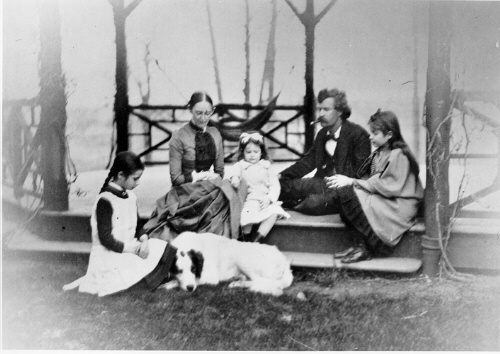
This year the state of Missouri is commemorating Mark Twain's life. 2010 is the 175th year after Twain's birth and the centinnial of the celebrated author's death. The "Father of American Literature" also has ties through his marriage to our Bragg family (Great-grandfather Frank
Martin Bragg and Olivia Langdon Clemons were 8th cousins). As the chart below with detail, descending from common ancestors George Hull and Thamzen Mitchel, Mark Twain's children and our Grandfather Bragg were 9th cousins (making our generation 9th cousins 2 times removed).

George Hull and Thamzen Mitchel
Mary Hull
b.1618
Lieutenant
Cornelius Hull b.1628
Nathaniel Pinney b.1640Cornelius Hull b.1655
Nathaniel Pinney ,Jr. b.1671Nathaniel Hull b.1694
Nathaniel Pinney III b.1695Nathaniel Hull b.1726
Lucretia Pinney b.1721Ezekiel Hull b.1765
Moses Barnard b.1750Platt Hull b.1787
Olive Barnard b.1785
Ezekiel Hull b.1813
Olivia Lewis b.1805
Rebecca L. Hull b.1841
Olivia Langdon b.1835Frank Martin Bragg b.1867
Langdon ClemensOrval Bishop Bragg b.1895

Don Cicero Bragg b.1920


[1] Gayle Harper, Missouri's Shining Star, Midwest Traveler, May/June
2010, 28-31.

[2] Mark Twain House and Museum
http://www.marktwainhouse.org/theman/bio.shtml

[3] Samuel Langhorne CLEMENS
http://people.brandeis.edu/~teuber/twainbio.html

[4] Consolatio
http://www.consolatio.com/2008/04/mark-twain-afte.html

[5] Source for picture of Mark Twain's family
http://ct.gov/sots/cwp/view.asp?a=3188&q=392624

Thursday, April 22, 2010

Did You Know #22

Just browsing over the various entries posted on this blog it is clear that our "little" family has deep roots in the history of our great nation. As our family tree is expanded we find famous generals, governors, a vice president, etc. Distant relatives have left their mark in places which they at the very least helped found (i.e. Barnstable, MA; Andover, ME, Sparta, MO), and perhaps even named in their honor (i.e. Hull, MA).

Distant relatives have also made an impact on our culture (i.e. Henry Fonda, Larry Bird, etc.). And for the older generations among us (and I shudder at the thought of having to include myself in this category), no one individual better represented the essence of Americana than Norman Rockwell.

For years readers looked forward to Rockwell's famous art gracing the cover of the Saturday Evening Post, paintings that became iconic. Rockwell captured in his work the bonds of family and patriotism held so dear to the hearts of Americans. Everyone seemed to have their favorite Rockwell creation.

According to the Norman Rockwell Museum, "Americans first knew and loved Norman Rockwell's art as it appeared on and between the covers of America's most popular magazines. These magazine covers, advertisements, and illustrations are the heart of the collection" of Rockwell paintings now preserved at the Norman Rockwell Museum.of Vermont.


Our family connection with Norman Rockwell goes all the way back to Edmund and Joan Makin.Sherman, my 11th great-grandparents and Norman Rockwell's 8th great-grandparents. Our great-grandfather, Frank Martin Bragg, and Norman Rockwell were 9th cousins. Here is the family connection:

Bragg Family
Rockwell Family
Edmund Sherman (1572-1641) and Joan Makin
Esther (or Hester) Sherman b.1606 Rev. John Sherman b.1613
Esther Ward b.1623 Rev. James Sherman b.1651
Daniel Burr b.1660 Dr. John Sherman b.1683
Elizabeth Burr b.1696 Phineas Sherman b.1719
Nathaniel Hull b.1726 Lemuel Sherman b.1750
Ezekiel Hull b.1765 Jacob Sherman b.1779
Platt Hull b.1787
Orilla Janes Sherman b.1808
Ezekiel Hull b.1813 John William Rockwell
Rebecca L. Hull b.1841 Jarvis Waring Rockwell
Frank Martin Bragg b.1867 Norman Percival Rockwell b.1894
Orval Bishop Bragg b.1895
Don Cicero Bragg b.1920


Tuesday, March 16, 2010

Did You Know? #20

Even though he has been dead for nearly 28 years his face is easily recognized all around the world, and his life's work continues to entertain. Among the long list of his life's work include some of the greatest movies ever made, such as: The Tin Star; The Ox-Bow Incident; Mister Roberts; Yours, Mine and Ours; Fort Apache; 12 Angry Men; How the West Was Won; The Grapes of Wrath.

He is also fondly remembered for his limited, but powerful presence in the television western, The Deputy.

Born on May 16, 1905 in Grand Island, Nebraska, he was the son of William Brace Fonda and Elma Herberta Jaynes. William was a printer. Henry had early dreams of life as a journalist which lead him to the University of Minnesota, where he majored in journalism. He never completed his university studies, taking a job with a credit company before starting his acting career, at the urging of Marlon Brando's mother, in Omaha. Henry was 20 at the time. His acting career lead him to Cape Cod, MA, where he joined an acting troup called the University Players. This is where he met his first wife, Margaret Sullavan. After the end of their brief marriage, Fonda moved to New York where he roomed with Jimmy Stewart and worked on the Broadway stage.

His first Hollywood movie role came in 1935 with The Farmer Takes a Wife, and, with Fred MacMurray in The Trail of the Lonesome Pine. That 1936 film just happened to be the very first film shot outdoors in Technicolor.

Fonda's second wife, Frances Ford Seymour, became the mother of a daughter, Jane (1937), and son, Peter (1940). Both of the Fonda children made a considerable impact as actors. Then came WW II, and the popular actor was driven to answer the call for armed service. Fonda joined the Navy, saying, "I don't want to be in a fake war in a studio."[1]

After three years of active duty, Henry earned a Presidential Citation and was awarded the Bronze Star. After his wife committed suicide in 1950, Henry would be married to Susan Blanchard, stepdaughter of Oscar Hammerstein, in 1950, to Italian Countess Afdera Franchetti in 1957, and to Shirlee Mae Adams from 1965 until his death in 1982.

Henry Jaynes Fonda's career was also highlighted with great accolades including an Academy Award for On Golden Pond, the Lifetime Achievement Award, Emmy nominations, Golden Globe Award, and a Tony Award for Mister Roberts.

In addition, Henry Fonda received the American Film Institute's Life Achievement Award in 1978 and, in 1999, that same group named him the sixth Greatest Male Star of All Time.

His acting career continued after the war all the way to the early 1980's. In 1979 he appeared in Wanda Nevada with his son, Peter, and in 1981 with daughter Jane in On Golden Pond. The latter film was his last before the beloved actor passed away on August 12, 1982.

The relationship between our Bragg family and Henry Fonda can be traced backwards to our father's 10th great-grandparents, Edmund Sherman & Joan Makin, who also is the 8th great-grandparents of Henry Fonda. Below is a chart demonstrating the connection.

Edmund Sherman & Joan Makin
Esther (or Hester) Sherman b.1606
sisters
Grace Sherman b.1616
Esther Ward b.1623
1st cousins Samuel Livermore b.1640
Daniel Burr b.1660
2nd cousins Anna Livermore b.1691
Elizabeth Burr b.1696
3rd cousins Abijah Bemis b.1723
Nathaniel Hull b.1726
4th cousins Beulah Bemis b.1759
Ezekiel Hull b.1765
5th cousins Lydia Pike b.1788
Platt Hull b.1787
6th cousins Almira Jacobs b.1827
Ezekiel Hull b.1813
7th cousins Henry Silas Jaynes b.1848
Rebecca L. Hull b.1841
8th cousins Herberta Krueger Jaynes b.1879
Frank Martin Bragg b.1867
9th cousins Henry Fonda b.1905
Orval Bishop Bragg b.1895
9th cousins, once removed
Don Cicero Bragg b.1920
9th cousins, twice removed

Monday, March 01, 2010

Did You Know? #19


In the formative years of our great country, few families had a greater impact than the Beechers. Headed by Lyman Beecher [pictured to the right] (1775-1863), a sixth generation American, he presided over a large family that proudly followed his example of activism and education that helped to shape America in the nineteenth century.

Rev. Lyman Beecher effectively Beecher family who distinguished himself as a minister and educator, the family made major contributions. By the time he was fifty, Beecher was "one of the best known preachers in the country."
[1] Educated at Yale University (1797), Beecher served as a Presbyterian minister in Long Island, New York (1799), Litchfield, Connecticut (1810), Boston, Massachusetts (1826), and Cincinnati, Ohio (1832). He was especially known for his strong sermons against the institution of slavery and the use of alcohol. During his tenure in Boston he was greatly embarrassed when the two-year-old meeting house caught fire and it was discovered that the fire started in a room rented by a local merchant who, without the knowledge church officials, used the room to store his inventory of whiskey, the subject of so many of his fiery sermons.

In addition to his ministry, Beecher devoted much of his life to enhancing America's educational system. When he made the decision to move "west" (i.e. Ohio), he explained his motivation to one of his daughters this way: "I have thought seriously of going over to Cincinnati, the London of the West, to spend the remnant of my days in the great conflict, and in consecrating all my children to God in that region who are willing to go. If we gain the West, all is safe; if we lose it, all is lost. (The Autobiography of Lyman Beecher, ed. Barbara M. Cross, vol.2, p.167 as quoted in Rugoff p.78)."
[2] Beecher served as president of Lane Theological Seminary, in Cincinnati, Ohio, from 1832 until his retirement in 1850. Here he continued his crusade to stamp out slavery and dry up the whiskey, a mission his offspring eagerly continued after the elderly Beecher's retirement.

Lyman Beecher married twice. With his first wife, Roxanna Foote (1775-1816, they married in 1799), he nine children, and four more with his second wife, Harriet Porter (1790-1835; they married in 1817). Among his offspring many became influential in their own right. Catherine Beecher (1800-1878) started her own private school for young women, the Hartford Female Seminary, in Hartford, Connecticut, in "May 1823, and it remained an important institution for the education of women for more than sixty years."
[3] When the family moved west she started another school, Western Female Institute in Cincinnati, and "was instrumental in the founding of women's colleges at Burlington, Iowa, Quincy, Illinois, and Milwaukee, Wisconsin." [4] Catherine is recognized today as one of the first promoters of women's education and health issues.

William Henry Beecher (1802-1889), Lyman and Roxanna's second child, served as a missionary and educator. So did the third child, Edward (1803-1895; ("the first president of Illinois College at Jacksonville," 1830 [5]), and the eighth Henry Ward Beecher [pictured to the left] (1813-1887; the most famous of the Beecher sons). Like his father, Henry Ward Beecher was an influential and outspoken advocate of the abolition cause. In many ways he followed in his father's footsteps, well educated and passionate in his preaching, Henry Ward Beecher was a prolific writer and a forceful voice against alcohol and slavery. He preached for large Presbyterian churches in Indianapolis, Indiana and Brooklyn, New York. He was one of the most famous preachers in America when, in the mid-1870s, he was caught up in a scandal over an alleged affair with the wife of one of the church’s influential members. Transcripts of the public trial were originally printed in the New York Times, and later published in book form. Acquitted of the charges, he continued to be a popular author, lecturer, and minister until his death. [6]

A year after the death of his first wife, Lyman Beecher married Harriet Porter (1790-1835). Of the four children born from this marriage, Isabella (1822-1907) took up the causes championed by her oldest half-sister Catherine as an educator and activist for women's issues. [7] Also, two of Lyman and Harriet's sons became missionaries and ministers (Thomas Kinnicut Beecher and James Chaplin Beecher).


However, the most famous of Lyman and Roxanna Beecher's children was their seventh child, Harriet Elizabeth Beecher [pictured to the right] (1811-1896). In her early life she worked closely with her oldest sister, Catherine. In 1836 she married Calvin Ellis Stowe (1802-1886), a recent widower who taught under her father at Lane Theological Seminary. He encouraged his wife to write, and write she did. Her most poplar work was and anti-slavery work entitled Uncle Tom's Cabin (first printed in an anti-slavery newspaper, The National Era, from 1851 to 1852, printed in book form later). [8] The story, "to some extent based on true events and the life of Josiah Henson," [9] became an instant sensation among the Northern abolitionist, even creating a frenzy of "Tom-mania" with songs, plays, and stories based on Harriet's book. [10] Harriet Beecher Stowe's writings were now in demand not only in America but even across the ocean. "The book received international recognition as a plea for the moral cause of abolition and is recognized today as a landmark in the history of American culture as well as American literature." [11] Over the remaining years of her life Harriet wrote a book a year, nearly 30, until her death in 1896. [Note: if you would like to download a free audio book of "Uncle Tom's Cabin," click here]

When she met President Abraham Lincoln, the President greeted her with, "So you're the little woman who wrote the book that started this great war." [12] I think it was wonderful that her father lived to see her success in a cause so near to his heart. Unfortunately, her mother, Roxanna, did not. Harriet could have hardly known her mother who died of tuberculosis at age of 41 (Harriet was only four). Roxanna Foote Beecher was the granddaughter of Revolutionary War Gen. Andrew Ward V (1727-1799), and the 5th great-granddaughter of Andrew Ward I (1597-1659), the Governor of Connecticut. This same Andrew Ward I is also our 10th great-grandfather, making Harriet Beecher Stowe our 6th cousins 5 times removed. Here is the actual connection:

Andrew Ward I
[5th great-grandfather or Harriet Beecher Stowe
and
our 10th great-grandfather]
Esther Ward b.1623
Andrew Ward II
Daniel Burr b.1660 Andrew Ward III
Elizabeth Burr b.1696 Andrew Ward IV
Nathaniel Hull b.1726
General Andrew Ward V
Ezekiel Hull b.1765
Roxana Ward
Platt Hull b.1787
Roxana Foote, m. Lyman Beecher
Ezekiel Hull b.1813
Henry Ward Beecher / Harriet Beecher Stowe
Rebecca L. Hull b.1841
Frank Martin Bragg b.1867

Orval Bishop Bragg b.1895

Don Cicero Bragg b.1920


Sources:

[1] An American Family: The Beecher Tradition, LYMAN BEECHER http://newman.baruch.cuny.edu/digital/2001/beecher/lyman.htm
[2] Ibid.
[3] An American Family: The Beecher Tradition, CATHERINE BEECHER http://newman.baruch.cuny.edu/digital/2001/beecher/catherine.htm
[4] Ibid.
[5] An American Family: The Beecher Tradition, EDWARD BEECHER http://newman.baruch.cuny.edu/digital/2001/beecher/edward.htm>
[6] An American Family: The Beecher Tradition, HENRY WARD BEECHER http://newman.baruch.cuny.edu/digital/2001/beecher/henry.htm
[7] An American Family: The Beecher Tradition, ISABELLA BEECHER HOOKER http://newman.baruch.cuny.edu/digital/2001/beecher/isabella.htm
[8] Petri Liukkonen, Harriet Beecher Stowe (1811-1896) http://www.kirjasto.sci.fi/hbstowe.htm 2008.
[9] Ibid.
[10] An American Family: The Beecher Tradition, HARRIET BEECHER STOWE http://newman.baruch.cuny.edu/digital/2001/beecher/harriet.htm>
[11] Ibid.
[12] Petri Liukkonen, Harriet Beecher Stowe (1811-1896) http://www.kirjasto.sci.fi/hbstowe.htm 2008.