Monday, May 10, 2010

Did You Know? #23

Although raised in the great state of Illinois, since the mid-1980's we have resided in the border state of Missouri, beside the legendary muddy Mississippi, and in the city Mark Twain described as "situated on a hillside, and makes a handsome appearance." In those days Cape Girardeau was frequently visited by the many steamboats that fought their way up and were carried down the great river.

About 30 miles south of Cape the Mississippi welcomes the Ohio River as it runs past the southernmost town of Cairo. About 200 miles north of Cape is Twain's hometown of Hannibal (actually he was born just a bit south in Florida, MO and moved to Hannibal when he was 4 years old).

Samuel Langhorne Clemens was born in November 1835 just a few weeks after Halley's Comet started appearing. Twain was noted for commenting that he came in with Halley's Comet and that he would go out with it as well. Twain passed away on April 21, 1910, the day after Halley's Comet made its closest pass during its 1910 reappearance.[1]

In addition to his illustrious career as a writer, Clemons was also a printer's apprentice, typesetter, a riverboat pilot, a governmental secretary for the state of Nevada, a miner, a reporter and newspaper editor. In addition to all this he had a brief stint of military service with the Confederate army during the Civil War, although that does not seem to have lasted more than a couple of weeks.[2]

Yet, despite this brief association with the Confederates, Mark Twain became a close personal friend of U. S. Grant and was instrumental in getting Grant to write and publish his personal memoirs.

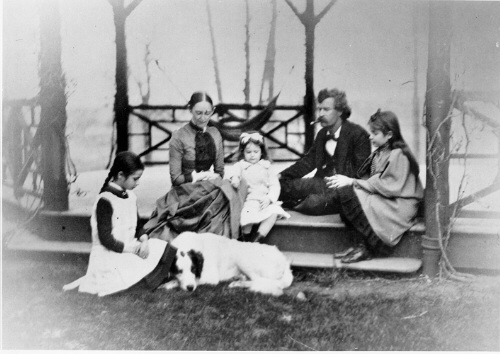
Clemons married Olivia Langdon on February 2, 1870 and the couple's children included Langdon, Olivia Susan, Clara, and Jean Lampton Clemens.[3] Following Olivia's death in 1904, Clemens, in a letter to his brother-in-law; declared, I am a man without a country. Wherever Livy was, that was my country."[4]

This year the state of Missouri is commemorating Mark Twain's life. 2010 is the 175th year after Twain's birth and the centinnial of the celebrated author's death. The "Father of American Literature" also has ties through his marriage to our Bragg family (Great-grandfather Frank
Martin Bragg and Olivia Langdon Clemons were 8th cousins). As the chart below with detail, descending from common ancestors George Hull and Thamzen Mitchel, Mark Twain's children and our Grandfather Bragg were 9th cousins (making our generation 9th cousins 2 times removed).

George Hull and Thamzen Mitchel
Mary Hull
b.1618
Lieutenant
Cornelius Hull b.1628
Nathaniel Pinney b.1640Cornelius Hull b.1655
Nathaniel Pinney ,Jr. b.1671Nathaniel Hull b.1694
Nathaniel Pinney III b.1695Nathaniel Hull b.1726
Lucretia Pinney b.1721Ezekiel Hull b.1765
Moses Barnard b.1750Platt Hull b.1787
Olive Barnard b.1785
Ezekiel Hull b.1813
Olivia Lewis b.1805
Rebecca L. Hull b.1841
Olivia Langdon b.1835Frank Martin Bragg b.1867
Langdon ClemensOrval Bishop Bragg b.1895

Don Cicero Bragg b.1920


[1] Gayle Harper, Missouri's Shining Star, Midwest Traveler, May/June
2010, 28-31.

[2] Mark Twain House and Museum
http://www.marktwainhouse.org/theman/bio.shtml

[3] Samuel Langhorne CLEMENS
http://people.brandeis.edu/~teuber/twainbio.html

[4] Consolatio
http://www.consolatio.com/2008/04/mark-twain-afte.html

[5] Source for picture of Mark Twain's family
http://ct.gov/sots/cwp/view.asp?a=3188&q=392624

Thursday, April 22, 2010

Did You Know #22

Just browsing over the various entries posted on this blog it is clear that our "little" family has deep roots in the history of our great nation. As our family tree is expanded we find famous generals, governors, a vice president, etc. Distant relatives have left their mark in places which they at the very least helped found (i.e. Barnstable, MA; Andover, ME, Sparta, MO), and perhaps even named in their honor (i.e. Hull, MA).

Distant relatives have also made an impact on our culture (i.e. Henry Fonda, Larry Bird, etc.). And for the older generations among us (and I shudder at the thought of having to include myself in this category), no one individual better represented the essence of Americana than Norman Rockwell.

For years readers looked forward to Rockwell's famous art gracing the cover of the Saturday Evening Post, paintings that became iconic. Rockwell captured in his work the bonds of family and patriotism held so dear to the hearts of Americans. Everyone seemed to have their favorite Rockwell creation.

According to the Norman Rockwell Museum, "Americans first knew and loved Norman Rockwell's art as it appeared on and between the covers of America's most popular magazines. These magazine covers, advertisements, and illustrations are the heart of the collection" of Rockwell paintings now preserved at the Norman Rockwell Museum.of Vermont.


Our family connection with Norman Rockwell goes all the way back to Edmund and Joan Makin.Sherman, my 11th great-grandparents and Norman Rockwell's 8th great-grandparents. Our great-grandfather, Frank Martin Bragg, and Norman Rockwell were 9th cousins. Here is the family connection:

Bragg Family
Rockwell Family
Edmund Sherman (1572-1641) and Joan Makin
Esther (or Hester) Sherman b.1606 Rev. John Sherman b.1613
Esther Ward b.1623 Rev. James Sherman b.1651
Daniel Burr b.1660 Dr. John Sherman b.1683
Elizabeth Burr b.1696 Phineas Sherman b.1719
Nathaniel Hull b.1726 Lemuel Sherman b.1750
Ezekiel Hull b.1765 Jacob Sherman b.1779
Platt Hull b.1787
Orilla Janes Sherman b.1808
Ezekiel Hull b.1813 John William Rockwell
Rebecca L. Hull b.1841 Jarvis Waring Rockwell
Frank Martin Bragg b.1867 Norman Percival Rockwell b.1894
Orval Bishop Bragg b.1895
Don Cicero Bragg b.1920


Tuesday, March 16, 2010

Did You Know? #20

Even though he has been dead for nearly 28 years his face is easily recognized all around the world, and his life's work continues to entertain. Among the long list of his life's work include some of the greatest movies ever made, such as: The Tin Star; The Ox-Bow Incident; Mister Roberts; Yours, Mine and Ours; Fort Apache; 12 Angry Men; How the West Was Won; The Grapes of Wrath.

He is also fondly remembered for his limited, but powerful presence in the television western, The Deputy.

Born on May 16, 1905 in Grand Island, Nebraska, he was the son of William Brace Fonda and Elma Herberta Jaynes. William was a printer. Henry had early dreams of life as a journalist which lead him to the University of Minnesota, where he majored in journalism. He never completed his university studies, taking a job with a credit company before starting his acting career, at the urging of Marlon Brando's mother, in Omaha. Henry was 20 at the time. His acting career lead him to Cape Cod, MA, where he joined an acting troup called the University Players. This is where he met his first wife, Margaret Sullavan. After the end of their brief marriage, Fonda moved to New York where he roomed with Jimmy Stewart and worked on the Broadway stage.

His first Hollywood movie role came in 1935 with The Farmer Takes a Wife, and, with Fred MacMurray in The Trail of the Lonesome Pine. That 1936 film just happened to be the very first film shot outdoors in Technicolor.

Fonda's second wife, Frances Ford Seymour, became the mother of a daughter, Jane (1937), and son, Peter (1940). Both of the Fonda children made a considerable impact as actors. Then came WW II, and the popular actor was driven to answer the call for armed service. Fonda joined the Navy, saying, "I don't want to be in a fake war in a studio."[1]

After three years of active duty, Henry earned a Presidential Citation and was awarded the Bronze Star. After his wife committed suicide in 1950, Henry would be married to Susan Blanchard, stepdaughter of Oscar Hammerstein, in 1950, to Italian Countess Afdera Franchetti in 1957, and to Shirlee Mae Adams from 1965 until his death in 1982.

Henry Jaynes Fonda's career was also highlighted with great accolades including an Academy Award for On Golden Pond, the Lifetime Achievement Award, Emmy nominations, Golden Globe Award, and a Tony Award for Mister Roberts.

In addition, Henry Fonda received the American Film Institute's Life Achievement Award in 1978 and, in 1999, that same group named him the sixth Greatest Male Star of All Time.

His acting career continued after the war all the way to the early 1980's. In 1979 he appeared in Wanda Nevada with his son, Peter, and in 1981 with daughter Jane in On Golden Pond. The latter film was his last before the beloved actor passed away on August 12, 1982.

The relationship between our Bragg family and Henry Fonda can be traced backwards to our father's 10th great-grandparents, Edmund Sherman & Joan Makin, who also is the 8th great-grandparents of Henry Fonda. Below is a chart demonstrating the connection.

Edmund Sherman & Joan Makin
Esther (or Hester) Sherman b.1606
sisters
Grace Sherman b.1616
Esther Ward b.1623
1st cousins Samuel Livermore b.1640
Daniel Burr b.1660
2nd cousins Anna Livermore b.1691
Elizabeth Burr b.1696
3rd cousins Abijah Bemis b.1723
Nathaniel Hull b.1726
4th cousins Beulah Bemis b.1759
Ezekiel Hull b.1765
5th cousins Lydia Pike b.1788
Platt Hull b.1787
6th cousins Almira Jacobs b.1827
Ezekiel Hull b.1813
7th cousins Henry Silas Jaynes b.1848
Rebecca L. Hull b.1841
8th cousins Herberta Krueger Jaynes b.1879
Frank Martin Bragg b.1867
9th cousins Henry Fonda b.1905
Orval Bishop Bragg b.1895
9th cousins, once removed
Don Cicero Bragg b.1920
9th cousins, twice removed

Monday, March 01, 2010

Did You Know? #19


In the formative years of our great country, few families had a greater impact than the Beechers. Headed by Lyman Beecher [pictured to the right] (1775-1863), a sixth generation American, he presided over a large family that proudly followed his example of activism and education that helped to shape America in the nineteenth century.

Rev. Lyman Beecher effectively Beecher family who distinguished himself as a minister and educator, the family made major contributions. By the time he was fifty, Beecher was "one of the best known preachers in the country."
[1] Educated at Yale University (1797), Beecher served as a Presbyterian minister in Long Island, New York (1799), Litchfield, Connecticut (1810), Boston, Massachusetts (1826), and Cincinnati, Ohio (1832). He was especially known for his strong sermons against the institution of slavery and the use of alcohol. During his tenure in Boston he was greatly embarrassed when the two-year-old meeting house caught fire and it was discovered that the fire started in a room rented by a local merchant who, without the knowledge church officials, used the room to store his inventory of whiskey, the subject of so many of his fiery sermons.

In addition to his ministry, Beecher devoted much of his life to enhancing America's educational system. When he made the decision to move "west" (i.e. Ohio), he explained his motivation to one of his daughters this way: "I have thought seriously of going over to Cincinnati, the London of the West, to spend the remnant of my days in the great conflict, and in consecrating all my children to God in that region who are willing to go. If we gain the West, all is safe; if we lose it, all is lost. (The Autobiography of Lyman Beecher, ed. Barbara M. Cross, vol.2, p.167 as quoted in Rugoff p.78)."
[2] Beecher served as president of Lane Theological Seminary, in Cincinnati, Ohio, from 1832 until his retirement in 1850. Here he continued his crusade to stamp out slavery and dry up the whiskey, a mission his offspring eagerly continued after the elderly Beecher's retirement.

Lyman Beecher married twice. With his first wife, Roxanna Foote (1775-1816, they married in 1799), he nine children, and four more with his second wife, Harriet Porter (1790-1835; they married in 1817). Among his offspring many became influential in their own right. Catherine Beecher (1800-1878) started her own private school for young women, the Hartford Female Seminary, in Hartford, Connecticut, in "May 1823, and it remained an important institution for the education of women for more than sixty years."
[3] When the family moved west she started another school, Western Female Institute in Cincinnati, and "was instrumental in the founding of women's colleges at Burlington, Iowa, Quincy, Illinois, and Milwaukee, Wisconsin." [4] Catherine is recognized today as one of the first promoters of women's education and health issues.

William Henry Beecher (1802-1889), Lyman and Roxanna's second child, served as a missionary and educator. So did the third child, Edward (1803-1895; ("the first president of Illinois College at Jacksonville," 1830 [5]), and the eighth Henry Ward Beecher [pictured to the left] (1813-1887; the most famous of the Beecher sons). Like his father, Henry Ward Beecher was an influential and outspoken advocate of the abolition cause. In many ways he followed in his father's footsteps, well educated and passionate in his preaching, Henry Ward Beecher was a prolific writer and a forceful voice against alcohol and slavery. He preached for large Presbyterian churches in Indianapolis, Indiana and Brooklyn, New York. He was one of the most famous preachers in America when, in the mid-1870s, he was caught up in a scandal over an alleged affair with the wife of one of the church’s influential members. Transcripts of the public trial were originally printed in the New York Times, and later published in book form. Acquitted of the charges, he continued to be a popular author, lecturer, and minister until his death. [6]

A year after the death of his first wife, Lyman Beecher married Harriet Porter (1790-1835). Of the four children born from this marriage, Isabella (1822-1907) took up the causes championed by her oldest half-sister Catherine as an educator and activist for women's issues. [7] Also, two of Lyman and Harriet's sons became missionaries and ministers (Thomas Kinnicut Beecher and James Chaplin Beecher).


However, the most famous of Lyman and Roxanna Beecher's children was their seventh child, Harriet Elizabeth Beecher [pictured to the right] (1811-1896). In her early life she worked closely with her oldest sister, Catherine. In 1836 she married Calvin Ellis Stowe (1802-1886), a recent widower who taught under her father at Lane Theological Seminary. He encouraged his wife to write, and write she did. Her most poplar work was and anti-slavery work entitled Uncle Tom's Cabin (first printed in an anti-slavery newspaper, The National Era, from 1851 to 1852, printed in book form later). [8] The story, "to some extent based on true events and the life of Josiah Henson," [9] became an instant sensation among the Northern abolitionist, even creating a frenzy of "Tom-mania" with songs, plays, and stories based on Harriet's book. [10] Harriet Beecher Stowe's writings were now in demand not only in America but even across the ocean. "The book received international recognition as a plea for the moral cause of abolition and is recognized today as a landmark in the history of American culture as well as American literature." [11] Over the remaining years of her life Harriet wrote a book a year, nearly 30, until her death in 1896. [Note: if you would like to download a free audio book of "Uncle Tom's Cabin," click here]

When she met President Abraham Lincoln, the President greeted her with, "So you're the little woman who wrote the book that started this great war." [12] I think it was wonderful that her father lived to see her success in a cause so near to his heart. Unfortunately, her mother, Roxanna, did not. Harriet could have hardly known her mother who died of tuberculosis at age of 41 (Harriet was only four). Roxanna Foote Beecher was the granddaughter of Revolutionary War Gen. Andrew Ward V (1727-1799), and the 5th great-granddaughter of Andrew Ward I (1597-1659), the Governor of Connecticut. This same Andrew Ward I is also our 10th great-grandfather, making Harriet Beecher Stowe our 6th cousins 5 times removed. Here is the actual connection:

Andrew Ward I
[5th great-grandfather or Harriet Beecher Stowe
and
our 10th great-grandfather]
Esther Ward b.1623
Andrew Ward II
Daniel Burr b.1660 Andrew Ward III
Elizabeth Burr b.1696 Andrew Ward IV
Nathaniel Hull b.1726
General Andrew Ward V
Ezekiel Hull b.1765
Roxana Ward
Platt Hull b.1787
Roxana Foote, m. Lyman Beecher
Ezekiel Hull b.1813
Henry Ward Beecher / Harriet Beecher Stowe
Rebecca L. Hull b.1841
Frank Martin Bragg b.1867

Orval Bishop Bragg b.1895

Don Cicero Bragg b.1920


Sources:

[1] An American Family: The Beecher Tradition, LYMAN BEECHER http://newman.baruch.cuny.edu/digital/2001/beecher/lyman.htm
[2] Ibid.
[3] An American Family: The Beecher Tradition, CATHERINE BEECHER http://newman.baruch.cuny.edu/digital/2001/beecher/catherine.htm
[4] Ibid.
[5] An American Family: The Beecher Tradition, EDWARD BEECHER http://newman.baruch.cuny.edu/digital/2001/beecher/edward.htm>
[6] An American Family: The Beecher Tradition, HENRY WARD BEECHER http://newman.baruch.cuny.edu/digital/2001/beecher/henry.htm
[7] An American Family: The Beecher Tradition, ISABELLA BEECHER HOOKER http://newman.baruch.cuny.edu/digital/2001/beecher/isabella.htm
[8] Petri Liukkonen, Harriet Beecher Stowe (1811-1896) http://www.kirjasto.sci.fi/hbstowe.htm 2008.
[9] Ibid.
[10] An American Family: The Beecher Tradition, HARRIET BEECHER STOWE http://newman.baruch.cuny.edu/digital/2001/beecher/harriet.htm>
[11] Ibid.
[12] Petri Liukkonen, Harriet Beecher Stowe (1811-1896) http://www.kirjasto.sci.fi/hbstowe.htm 2008.

Thursday, February 04, 2010

Did You Know #18

I love flying into Boston. Not only does it mean that we will be able to see our son, Nathan, and his wife, Carissa, but if the weather is clear we will be treated to an amazing view as we fly out over the Atlantic, circle around over Boston harbor.

Here is a picture I took the last time we made the trip. Since we had to circle Boston twice before landing I especially noticed this peninsula jutting out into the harbor.. In my recent studies of our family history I learned that the particular land mass in that picture is the town of Hull, MA. Immediately mental "flags" went up. I had to learn more.

The land upon which Hull, MA now stands was originally known as Nantasket. The settlement that would become Hull, MA can be traced "across the pond" to the religious turmoil in England. In search for the freedom of religion for which they yearned a group of "pilgrims" made the trip to the New World. One of the leaders of this exodus was the Rev. Joseph Hull (1596-1665).

The group of 105 immigrants was known as "Hulls Colony" arrived in Boston, MA on May 6, 1635 he arrived at Boston, MA on, many historians believe, as ship named "Mary Gould/Gold" [1] They originally settled in Weymouth, MA. On :"July 8, 1635, the General Court of Boston passed an order giving permission to the Rev. Joseph Hull, with twenty-one families numbering about one hundred persons, to settle at Wessagusset" (today known as Weymouth, MA). [2]

Hull moved from Weymouth about a year later and settled in Nantasket, where the towns of Hingham and Hull now stand, and a couple of years after that (1636) he moved to, and established the town of Barnstable on Cape Cod land granted to him. [3] "in 1639 to the Old Colony of Plymouth, and there founded the present town of Barnstable, at a place called by the Indians, Mattakeese. The rock still stands in the middle of the highway, from which he preached, surrounded by his armed parishioners." [4]

In 1641 Hull moved to nearby Yarmouth after becoming in a dispute with the religious authorities under which he served. [5] According to the Barnstable church records, Hull soon "acknowledged his sin and was again received" into the fellowship of the Barnstable church. However, by the end of 1643 he moved to York, ME.

Joseph Hull returned to England, where he resided from 1652 until his return to New England in 1662. [6] He died on November 19, 1665 "at Isles of Shoals, leaving an estate valued at 52 pounds, 5 shillings and 5 pence -- 10 pounds of which was put down for books, and 20 pounds as due him from the Isle of Shoals for his ministry." [7]

While many websites assert that the town of Hull, MA was named for a town in England, which in turn is named for a nearby river, Hull, it would come as no surprise to find, in sources dedicated to Rev. Joseph Hull that his name would be associated with the town. However, the History of Weymouth Massachusetts notes that in 1644 "Nantasket was made a town and named "Hull," in the honor of Rev. Joseph Hull." [8]

The Hull family has been traced backwards from Joseph Hull to his great-grandfather:

William Hull (1484)
Richard Hull (1515-1559)
Thomas Hull (1547-1612)

Thomas (1547) and Joan Peson, Joseph's parents, had ten other children. One of Joseph's older brothers was George (Aug. 27, 1590-Dec. 29, 1659), who is our 10th great-grandfather:

George Hull b.1590
Lieutenant Cornelius Hull b.1628
Cornelius Hull b.1654
Nathaniel Hull b.1694
Nathaniel Hull b.1726
Ezekiel Hull b.1765
Platt Hull b.1787
Ezekiel Hull b.1813
Rebecca L. Hull b.1841 (married William Bragg)
Frank Martin Bragg b.1867
Orval Bishop Bragg b.1895
Don Cicero Bragg b.1920

This would make Rev. Joseph Hull our 10th great-grand uncle. George Hull was a "surveyor, Indian trader, magistrate, statesman," who settled the town of Dorchester, Massachusetts, about 1630, then removed in 1636 to Windsor, Connecticut.

The Hull family has a rich history in New England. Allow me to introduce you to a few Hull family members that caught my eye.

One of Joseph's son, Capt. Tristam Hull (1624), was a mariner and leading citizen of Barnstable, MA while another, Joseph (1622) "was apparently a son in disgrace at York, Maine, in February 1644/45. He is no later mentioned." [9] While Capt. Tristam Hull was highly respected in church and community, the same could not be said for his wife.

"In March 1656 John Gorum was fined forty shillings "for unseemly carriage toward Blanche Hull at an unseasonable time, being in the night." Blanche Hull was fined fifty shillings "for not crying out when she was assaulted by John Gorum in unseemly carriage towards her." Both Gorum and Blanche were married at this time, Gorum to Desire Howland, eldest daughter of John Howland and his wife, Elizabeth Tilley Howland, and Blanche to Tristram Hull. The court evidently considered Blanche to have been a willing participant rather than a victim." [10]

Shortly after Tristam Hull's death, his widow Blanche married Captain William Hedges who was many years her senior. The marriage was apparently not a good one. When Capt. Hedges drew up his will he "left his second wife, Blanche Hull, widow of Tristram Hull, only a token twelve pence, "full eleven pence more than she deserved". And "also what I have received of hers shall be returned to her again," because she had deserted him."

Another son, Hopewell Hull (about 1636) was one of the founders of Piscataway, New Jersey.

One of Joseph's daughters, Naomi (1640), was left in the care of another family for the decade Joseph returned to England. In 1682 she "was the center of more trouble by speeches against her brother and sister"

Another daughter, Elizabeth Hull (1628), married John Heard in 1643. Heard was a master carpenter. Mr. Heard seemed to have freely shared his thoughts about others, a trait that kept community officials busy (for example, he was find by the court for "calling Edward Godfrey, Governor of York County, Maine, "Old Knave"). "The story of Elizabeth's experience on an exposed outpost where for a long time she was surrounded by hostile Indians has been told in detail by Cotton Mather in his Magnalia Christi Americana as well as in Belknap's History of New Hampshire and in Pikes Journal." [11]

John and Elizabeth Hull Heard's son, Samuel, married Experience Otis who was scalped by Indians on July 26, 1696. She not only survived that ordeal, she outlived her husband and went on to marry Rowland Jenkins.

***********************************

[1] Vol. I, History of Weymouth Massachusetts in four volumes [1923] published by the WEYMOUTH HISTORICAL SOCIETY, Wright and Potter Printing Company, Boston. To see the list of these immigrants at
http://www.immigrantships.net/v3/1600v3/hullcompany16330320.html>

[2] Chapter XV THE COMING OF THE HULL COMPANY.

[3] The General Court declared "that a warrant shall be directed to the Constable of Yarmouth to apprehend Mr. Joseph Hull (if he do either exercise his ministry amongst them or administer the Seals), to bring him before the next magistrate, to find sufficient sureties for his appearance at the next General Court, to answer his doings (being an excommunicant).""

[4]http://homepages.rootsweb.ancestry.com/~sam/jhull.html>

[5] Ibid.

[6] In England "he became Rector of St. Burien in
Cornwall, near Lands End
and remained there for ten years, at which time he was ejected from the
parish."

[7] The Isles of Shoals are a group if islands 10 miles S.E. of Portsmouth, NH. Maine-New Hampshire boundary now passes through them.

[8] http://www.donparrish.com/Report1/PS03/PS03_355.HTM>

[9] http://home.earthlink.net/~waresearcher/genealogy%20files/Rev_J_Hull_1549.rtf>

[10] http://homepages.rootsweb.ancestry.com/~sam/hull/tristram.html>

[11] http://homepages.rootsweb.ancestry.com/~sam/hull/elizabeth.html>
Cotton Mather wrote of Elizabeth Hull Heard: "During an unprovoked and cruel massacre of Indians by whites in 1676, Elizabeth saved the life of a young Indian boy by concealing him until his would-be slayers had left her house and then aided him to escape. Twelve years later she would fall into the hands of the Indians and would escape unharmed by the aid of this same Indian."

Thursday, December 03, 2009

Did You Know #17

In exploring the vast connections of the Bragg family throughout our well over 400 years in America, I noticed recurring confluences of the Bragg and Lincoln families. A branch of the New England Braggs, descending from Edward Bragg (b. 1616):

  • William Bragg married Lucinda Lincoln
  • Polly Bragg married Perez Lincoln
  • Eunice Bragg married Daniel Lincoln

While probing these intermarriages I came across an even closer connection as our section of the Bragg family tree intermarries with the Hull family (my great-great grandmother, Rebecca L. Hull, wife of William Bragg), and then with the Burr family (Elizabeth Burr, wife of Daniel Burr and my 7th great-grandmother). The Burr family then had a number of intermarriages with the Lincoln family:
  • Jonathan Burr married Mary Lincoln
  • Hannah Burr married Daniel Lincoln
  • Mary Burr married Moses Lincoln
Sifting through the various branches of the Lincoln family is a challenging proposal. According to the Hingham County, MA history, there were four adult Lincoln men named "Thomas." These were distinguished from each other by supplying each a middle name by each man's vocation. The result was:

  • Thomas "the weaver" Lincoln
  • Thomas "the husbandman" Lincoln
  • Thomas "the cooper" Lincoln
  • Thomas "the miller" Lincoln
Thanks to the frequent intermarriages between each of these branches increases the likelihood that one can make a strong case for a relationship with President Abraham Lincoln. After placing all the data I could find into my computer program, with an eye toward the frequently contradicting published family trees, I arrived at the following conclusion:
Martha Lincoln is my 5th cousin 8 times removed, both descendants of Symond Burr. Martha is also the 3rd cousin 2 times removed of Pres. Abraham Lincoln (both descendants of Samuel Lincoln and Martha Lyford).

The following chart traces out this conclusion:

Descendant List from Symond Burr & Joan Saunders

Henry Burr b.1556 ***** Jehue Burr b.1596
Simon Burr b.1616 ***** Jehu Burr b.1603
John Burr b.1659 ****** Jehue Burr b.1625
Jonathan Burr b.1697 ** Daniel Burr b.1660
Mary Burr b.1721 ***** Elizabeth Burr b.1696
(wife of Moses Lincoln) (wife of Nathaniel Hull)
Martha Lincoln b. 1745 Nathaniel Hull b.1726
********************* Ezekiel Hull b.1765
********************* Platt Hull b.1787
********************* Ezekiel Hull b.1813
********************* Rebecca L. Hull b.1841
********************* (wife of William Bragg)
********************* Orval Bishop Bragg b.1895
********************* Don Cicero Bragg b.1920
********************* David Bragg b.1958

Descendant List from Samuel Lincoln b. 1622 and Martha Lyford

Daniel Lincoln b.1652 ** Mordecai Lincoln b.1657
Martha Lincoln b.1694 * Mordecai Lincoln b.1686
Moses Lincoln b.1718 ** John Lincoln b. 1716
Martha Lincoln b. 1745 Abraham Lincoln b. 1744
********************* Thomas Lincoln b. 1778
********************* Pres. Abraham Lincoln b. 1809

Monday, November 09, 2009

Did You Know? #16

In a previous posting we investigated the connection from the Ethington side of our family with the Braggs who settled early in the Boston area before relocating to Maine. While connecting those "dots" was admittedly convoluted, to the say least, further study has opened up ,an even clearer connection with this somewhat isolated Bragg "cousins." While this connection is established from the Bragg side of our family tree, it did not come from the Braggs but the Munsons.

On February 4, 1918 Gladys Gilbreath and Orval Bishop Bragg were married. Grandma Bragg was one of five daughter's born to Cicero Gilbreath and Elvira Munson (pictured on the left). "Vie," as she was called, descended from Capt. Thomas Munson, "the ancestor of all the Munsons in the United States" <http://wc.rootsweb.ancestry.com/cgi-bin/igm.cgi?op=GET&db=dsb4&id=I0101>. Capt. Thomas (1612-1685) was Grandma Bragg's 7th great-grandfather. Upon his arrival in the New World, he made his home at Hartford, Connecticut prior to helping to found the village of New Haven, Connecticut where many "members of the Munson family were benefactors for establishing Yale University" (where Capt. Munson is buried in the Grove Street Cemetery, also the resting place of Eli Whitney, Noah Webster and Charles Goodyear; see <http://www.rootsweb.ancestry.com/~pasulliv/
settlers/settlers16/settlers16.html>). In fact, in August of 1987 Yale celebrated "The 350th Anniversary of Thomas Munson coming to America." Thomas' son, Samuel Munson (1642-1693), along with 38 others founded the town of Wallingford, Connecticut. To learn more, visit the Thomas Munson Foundation at http://www.thomasmunson.org/about_tm.asp

So how do the Munsons and the New England Bragg family intersect? The first chart below illustrates the lineage from Capt. Thomas Munson to Grandma Bragg (column 1). The lines divide with the brothers [marked in red] Solomon (1688) and Waitstill (1697), sons of Samuel Munson (1669). This would make Isaac Munson (1802, Grandma Bragg's great-grandfather) and Orpha Munson (1793) third cousins (you have to go up three generations to find their common ancestor) [marked in green].

Capt. Thomas Munson (1612-1685)
Samuel Munson b. 1643
Samuel Munson b. 1669
Solomon Munson b.1688
Waitstill Munson b.1697
Samuel Munson b.1717
Samuel Munson b.1724
Samuel Munson Jr. b.1763
Waitstill Munson b.1760
Isaac Munson b.1802
Orpha Munson b.1793
Joel Munson b.1846

Elvira Belle Munson b.1871

Gladys Gilbreath b.1898


Based on this, we can identify Grandma Bragg and Orpha Munson as 3rd cousins 3 times removed. The next chart demonstrates the further connection between Orpha Munson's parents, Waitstill Munson (1760) and Elizabeth Frisbie (1757),who were 2nd cousins 1 time removed. Their common ancestor is Samuel Munson a(1643). Waitstill's great-grandfather Samuel and Elizabeth's grandfather Caleb were brothers [marked in red].

Capt. Thomas Munson (1612-1685)
Samuel Munson b. 1643
Samuel Munson b. 1669
Caleb Munson b.1682
Waitstill Munson b.1697
Elizabeth Munson b.1717
(married Jedediah Frisbie in 1743)
Samuel Munson b.1724
Waitstill Munson b.1760
Elizabeth Frisbie b.1757
Orpha Munson b.1793

The final chart, below, completes the connection between the Munsons and the New England Bragg families. Orpha Munson married James Bragg, the great-great-grandson of Nicholas Bragg (1615), the brother of Edward Bragg (featured in Did You Know #12 <http://thebraggfamily.blogspot.com/2009/08/did-you-know-12.html>), sons of Nicholas Burton Bragge.

Capt. Thomas Munson (1612-1685)


Samuel Munson b. 1643
Nicholas Burton Bragge
Samuel Munson b. 1669
Caleb Munson b.1682
Nicholas Bragge b.1615
Edward Bragg b.1616
Waitstill Munson b.1697
Elizabeth Munson b.1717
(married Jedediah Friasbie in 1743)

Henry Bragg b.1657
Timothy Bragg
Samuel Munson b.1724

Alexander Bragg b.1689
Ebenezer Bragg
(married Zerviah
Brigham b.1698)
Waitstill Munson b.1760
Elizabeth Frisbie b.1757
Nicholas Bragg b.1732

Orpha Munson b.1793
James Bragg b.1784